| Genre | Children's Literature/NonFiction/Informational Text |
|---|---|
| Suggested Age | 10- 12 |
| Grade | 5th-7th |
| Lexile Level | 830 L |
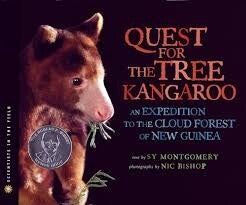
| Bibliographic Information | Montgomery, S. (2006). Quest for the tree kangaroo: An expedition to the cloud forest of New Guinea. Photographs by N. Bishop. Houghton Mifflin. |
Summary
“Quest for the Tree Kangaroo: An Expedition to the Cloud Forest of New Guinea” by Sy Montgomery is a nonfiction book that follows scientist Lisa Dabek and a team of researchers as they travel into the remote cloud forests of Papua New Guinea to study the elusive Matschie’s tree kangaroo. The book describes their difficult journey up the mountain, the planning and teamwork required for a field expedition, and the process of locating, safely capturing, and fitting radio collars on tree kangaroos so scientists can learn about their behavior, habitat, and how to protect them. Along the way, readers see the beauty and challenges of the cloud forest environment and get a sense of what daily life is like for field scientists working in rugged, unpredictable conditions.
The book also highlights broader themes of wildlife conservation and global citizenship, showing how local communities, guides, and schoolchildren in Papua New Guinea are involved in efforts to protect the tree kangaroos and their fragile habitat. Through clear, engaging text and vivid photographs, it teaches readers about the importance of biodiversity, the interconnectedness of people and ecosystems, and the patience and care required in scientific research.
Become a Global Citizen
“Quest for the Tree Kangaroo” is a strong piece of literature for children because it combines an exciting real-world adventure with clear, accessible science and stunning visuals. It invites young readers to follow a real research team into a distant cloud forest, making complex ideas like endangered species, ecosystems, and field research understandable and engaging. The narrative shows that scientists are curious, persistent people who work in teams and rely on both knowledge and problem-solving, which can help children see science as active and human rather than abstract or distant.
The book also supports important values and skills for children like, empathy for animals, respect for different cultures, and a sense of responsibility for the environment. By showing how local people, scientists, and children all play a role in conservation, it encourages readers to see themselves as capable of making a positive difference. The blend of narrative structure, informational content, and photographs models how nonfiction can be as compelling as fiction, helping children practice reading for information while still feeling like they are on an adventure.
Critique
“Quest for the Tree Kangaroo” has a clear, informative plot that follows a scientific expedition rather than a traditional fictional storyline. The “action” centers on planning the trip, traveling into the cloud forest, searching for the animals, and documenting what the team learns, so the tension comes from real-world challenges (weather, terrain, finding elusive animals) instead of invented conflict. This can feel slower than a typical adventure novel, but it works well for young readers who are curious about how science actually happens. The setting of the mountainous cloud forests of Papua New Guinea is one of the book’s strongest elements, described as remote, lush, and difficult to navigate, which helps children appreciate how unique and fragile this habitat is. Thematically, the book emphasizes conservation, curiosity, perseverance, and respect for local communities and wildlife, offering positive messages about caring for the planet and valuing scientific inquiry. The style is straightforward, descriptive, and age-appropriate, blending narrative storytelling with factual explanation and photographs so that children can both follow a story and learn information. The point of view is third-person, focused mainly on the scientist Lisa Dabek and her team, which allows readers to see the work from an observational, documentary-like perspective; this distance can make it slightly less emotionally intimate than a first-person story, but it reinforces the book’s purpose as an informative, nonfiction account.

Lesson Sketch
This is where our journey begins. Get to know our business and what we do, and how we're committed to quality and great service. Join us as we grow and succeed together. We're glad you're here to be a part of our story.
Objective:
Fourth grade students will listen to the teacher read selected pages aloud and participate in a discussion and then will identify and explain one main idea about wildlife conservation from "Quest for the Tree Kangaroo" and support it with at least two details from the text or images in a written or illustrated response that is complete and accurate in at least 2 of 3 required details.
Standard:
CCSS.ELA-LITERACY.RI.4.2: Determine the main idea of a text and explain how it is supported by key details; summarize the text.
Discussion Questions:
-
What challenges do the scientists face while trying to find and study the tree kangaroos, and what do these challenges show about doing fieldwork in nature?
-
Why do the scientists think it is important to learn more about tree kangaroos, and how could this information help protect them and their habitat?
-
How do the people who live near the cloud forest (guides, community members, or children) contribute to the expedition or to caring for the environment?
Lesson Activity
Activate prior knowledge (5–10 minutes)
-
Show the book cover and a few interior photos.
-
Ask students what they notice and what they predict the book will be about (animal, place, type of text: story vs. true information).
-
Record predictions on the board.
Guided reading / read-aloud (10–15 minutes)
-
Read a key section of the book aloud (for example, the part that describes traveling into the cloud forest and searching for tree kangaroos).
-
Pause to model thinking aloud: identify one possible main idea (e.g., “Studying animals in the wild is challenging but important”) and point out 1–2 supporting details from the text or photos.
Partner main-idea hunt (10–15 minutes)
-
In pairs, students receive a short excerpt or a set of 2–3 pages (printed or projected).
-
Each pair:
-
Underlines or notes important details about what the scientists do, the habitat, or why the animals need protection.
-
Writes one sentence stating a main idea and lists at least two supporting details from their section.
-
Share and discuss (10–15 minutes)
-
Pairs share their main ideas and details with the class.
-
As ideas are shared, the teacher groups them on the board (e.g., “challenges of fieldwork,” “importance of conservation,” “working with local people”).
-
Use the discussion questions to deepen understanding, especially around conservation and cooperation between scientists and local communities.
Individual response / exit task (5–10 minutes)
-
Students create a short written or illustrated response:
-
Write a paragraph or create a mini-poster that states one main idea about wildlife conservation from the book and includes at least two supporting details (from text or pictures).
-
-
Collect as an assessment of the objective (did they clearly state a main idea and support it with appropriate details?).
Resources
Click on the Link
This website is a starting point for teachers and has a could lesson plans to use alongside this book.
Click on the Link
This is a great read aloud if you have students that are struggling to read independently.
Create Your Own Website With Webador